 Castles
Rüdesheim
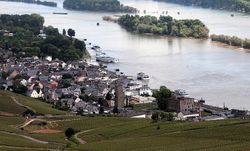
Rüdesheim is a historic city of winegrowers. Already the Romans grew wine here.
The old town, dating from the Middle Ages, and parts of the city's fortifications like the Adlerturm (eagle tower) are maintained. Here you will find cosy traditional wine taverns in historic half-timbered houses. No tourist leaves this international well-known city without visiting the world-famous Drosselgasse.
Drosselgasse
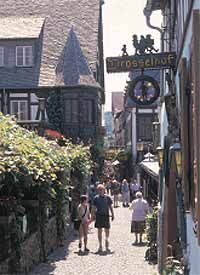
The Drosselgasse is the heart of Rüdesheim's old town, a “magnet” for tourists from all continents. Live band entertainment, brass instrument and dance music from late morning till midnight along the 144 m long Drosselgasse. Meet easy-going people while enjoying the regional cuisine, the Rüdesheim wine and music in the wine houses and garden taverns of this world-famous alley. Dancing the night away in the Drosselgasse
From March/April to December, several pubs along the Drosselgasse offer live music. There’s something for every musical taste, from Rhine party and brass music and guitar sounds to current chart hits. The music starts daily in April at approx. 19 p.m. In May you can already start dancing at 12 p.m. In November and during the Christmas market, the bands play every day from 19 p.m.
Sporting activities
Rüdesheim is vantage point for many sporting activities, such as: Walking on the Rheinsteig trail, Canoeing through the World Heritage or going on the romantic castle and palace bicycle tour.
The town offers lots of historic sites:
Brömserburg Castle
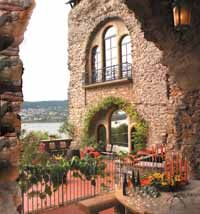
From the beginning of the 10th until the early 19th century, this old defensive fortress was the property of the archbishops of Mainz. It was converted into a residential castle in the 12th Century however. In earlier times it was directly situated on the Rhine, completely surrounded by water. Its more than two-meter thick (six-foot-plus) walls and meter-thick vault towers successfully withstood every attack. The Duke of Longville was able to destroy only the southeastern portion. A mined path to the Bergfried proves that this is where the destructive work failed.
Secularized in 1803, the castle had various owners until it was acquired by the city of Ruedesheim in 1941. Today it contains the significant collections of the Rheingauer Wine Museum. In the castle garden various old fermentation tanks from over the centuries can be found.
Boosenburg Castle
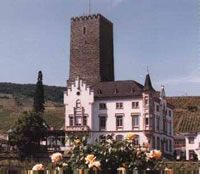
This Romanesque defensive tower is in the immediate proximity of the Broemserburg. Its construction reveals through its form that it had been erected around the 9th Century. With its 38 m height it dominated al other buildings in the city. Attached to its up to 3 m thick walls there was a castle-like residence. The entire property is now privately owned and, regrettably, not available for sightseeing.
Benedictine Abbey of St. Hildegard
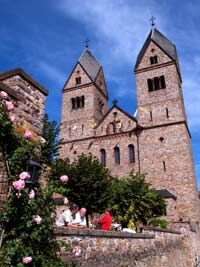
Visit the Benedictine Abbey of St Hildegard in the vineyards above Rüdesheim. You will find a lively monastery community, an abbey church worth seeing with a magnificent view of the Rhine valley.
There is also a modern bookshop with a large selection of books, cards, arts & crafts and ceramic items; a winery with selected wines, sparkling wines and liquors, and a large assortment of spelt products for healthy living. In other words: rest and relaxation for body and spirit.
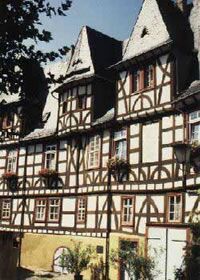
Klunkhardshof
The Klunkhardshof, one of the nicest relics of old Rüdesheim, is a two-storey half-timbered building from the early 16th Century. It was once the property of the highly respected Klunkhard family from which numerous spiritual dignitaries descended.
Adlerturm / Eagle Tower
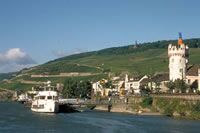
Located in the Rheinstraße, directly on the river bank, this Late Gothic corner tower built in the 15th century as a part of the city fortification. It is 20,5 m high with a 5 m interior diameter, 1 m thick walls, four floors and an underground dungeon accessible only through a hole in the vaulted ceiling. It was located close to the river. In winter, when the frozen up Rhine was safe for crossing on foot, a basket with combustible material was put on the tower as a fire signal. In the 19th century, when the Adlerturm housed an inn called “Zum Adler” (In the Eagle), Johann Wolfgang von Goethe, Germany’s greatest poet and literary man, frequently stayed here during his Rüdesheim visits in order to enjoy the magnificent view of the Rhine. Today the Adlerturm is the property of a bank.
Niederwalddenkmal
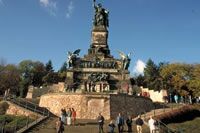
This monument was erected in the years 1877-1883, based on a design by Johann Schilling of Dresden. The almost 38 m high statue with the pathos so typical of its time no longer appeals to current taste. It symbolizes the re-establishment of the German empire which was a direct result of the outcome of the French-Prussian War of 1870-1871, leading to the unification of Germany under Prussian hegemony as an imperial monarchy.
The main figure is that of Germania, the classical mythic female figure representing Germany. In her raised right hand is the imperial crown. The imperial sword is in her left hand. For years the monument reflected national pride and the much belated creation of a single German nation. Today, within the context of “Europe,” such proud, almost bellicose feelings are totally passé. But it is an important relic of an epoch and an era, and, like the dinosaur, part of the past.
One can reach the Niederwald heights on foot, by car, or by chair lift from Rüdesheim and Assmannshausen. Standing in front of the monument, the marvellous view of Rheinland Pfalz across the river is surely one of the most beautiful in the world, particularly at dawn, dusk and sunset, and also by night, especially at full moon.
Current Loreley
Loreley guided tours
Tour „Enchanting Loreley”
Tour „Enchanting Loreley” including nature hike and wine tasting
Registration Loreley Tours
Fon: +49 (0) 6774 – 745
Fax: +49 (0) 6774 – 8174Mail: info@tempus-rhenus.de
Deutschland Germany information
Rhein river information
Loreley Info now mobile
|
|||||
| Source: Foto Loreleyfelsen Felix König | © 2006 - 2014 go_on Software GmbH |
||||



